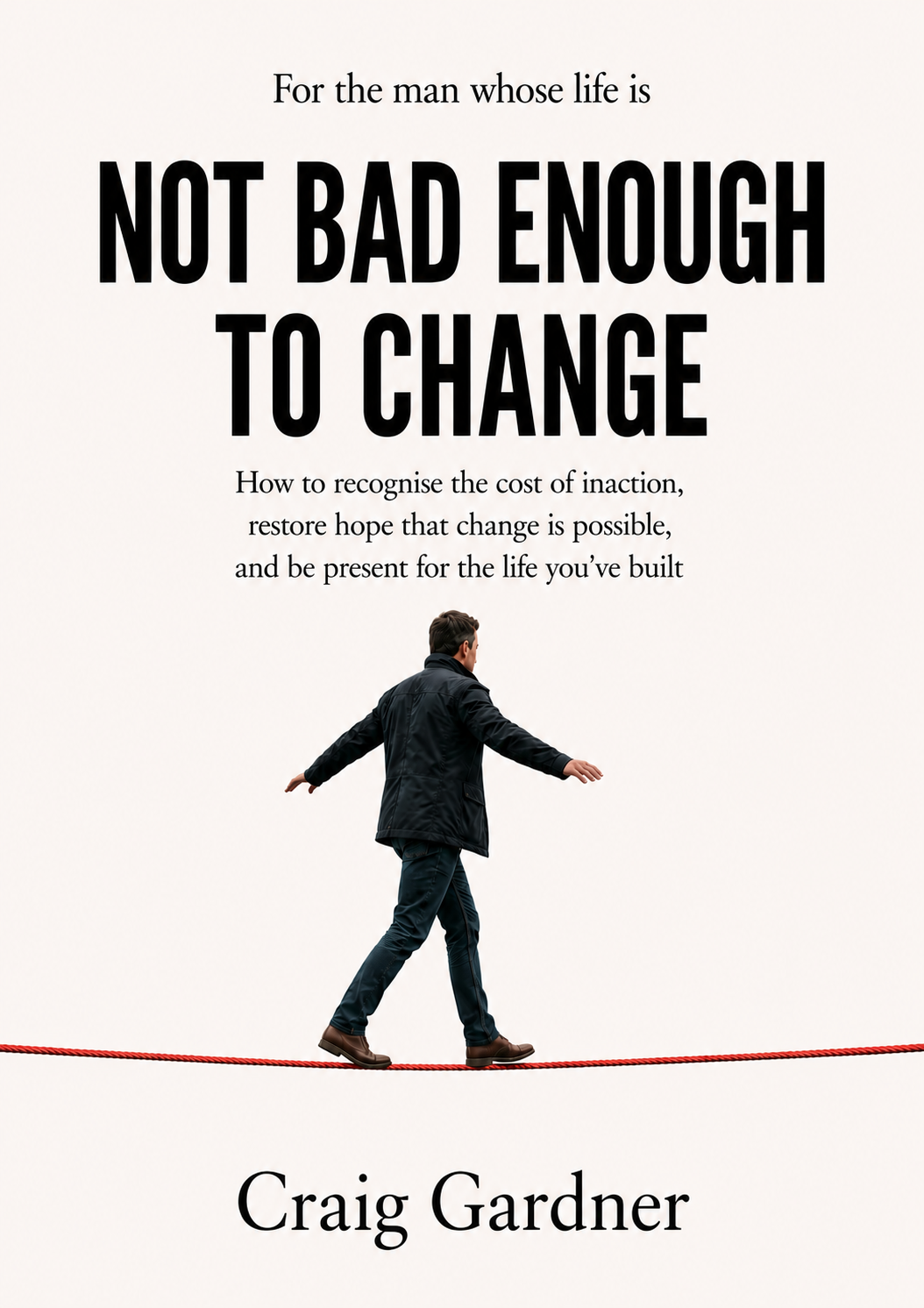
Not Bad Enough to Change
— A new book by Craig Gardner —

The Quiet Cost
of a Life
That Looks Fine

For the man who knows something is off, has known it for longer than he would admit, and has been waiting for a reason big enough to finally do something about it — this book makes that reason visible.

Get instant access - $20
Ebook only · Instant download

You know something is off.

Not broken. Not in crisis. Just... off. And the fact that it isn't broken is the whole problem, because broken things get fixed. This gets tolerated.

You tell yourself you just need to get through the next stretch. The launch, the quarter, the school holidays, the period after the school holidays when things finally settle. But the stretch never ends. It just changes shape. And the version of you that was going to deal with this once things calmed down never gets his turn.

Meanwhile, you are answering "I can't right now" to your kids without breaking stride. Sitting in the same room as your family on a Sunday afternoon, technically present, mentally already in Monday. Your wife asks how you are at 9pm and you say yeah, fine, just tired, and you both move on, because going any further would mean saying something you're not ready to say.

None of it is dramatic. That's what makes it survivable. And it is exactly what makes it dangerous.

There's no single moment significant enough to act on. So no moment gets acted on. They accumulate instead, quietly, at a rate you cannot see.

You've had the 2am thought. The one that arrives when there's no one left to perform for. Is this it? Is this actually it? Not with anger. Not even with self-pity. With a tiredness so complete it has become its own kind of silence. And by 7am it's folded back into the day, absorbed privately, the way these thoughts always are.

If this sounds familiar, you're not alone. And you are not broken.

But here is what nobody is saying clearly: the problem is not your discipline. It is not your circumstances, your motivation, or the market. The problem is that your life does not look bad enough to justify the scale of change you can feel is needed. And so you wait. You have been waiting for years. And the wait has a cost you cannot see from the inside.

The problem is that your life does not look bad enough to justify the scale of change you can feel is needed.

Why Knowing Hasn't Moved You

Most men believe they are one insight away from moving. Read the right book, find the right framework, hear the idea that finally lands, and they will act. So they keep consuming. Podcasts on the commute. Books half-finished. Courses they open and revisit. Programmes that feel like the answer, briefly.

That belief is understandable. It seems like the reasonable way to prepare. But it is costing you years.

Understanding why you are stuck has almost no relationship to getting unstuck. The men who are most articulate about what needs to change are often the ones who have been the most stuck, the longest. Including me. I spent fourteen years accumulating understanding without translating it into life. I knew more than most men about why I was drifting, and yet I kept drifting. The gap between what I understood and how I was actually moving through my days had become its own kind of existence.

The thinking is not the path through. For most men, the thinking has become the trap.

Why It Was Never Your Discipline

Every attempt you have made to change has probably followed the same logic: commit to something ambitious, execute it consistently, and over time become the person you intend to be. When it falls away, as it always does into an ordinary week, you draw a conclusion. That you lack discipline. That the timing wasn't right. That you are perhaps not the kind of man who can sustain things.

That conclusion is wrong. But it has been accumulating evidence for years, and now it runs quietly underneath every new attempt, shortening the runway before you stop.

The approach itself is the problem. Consistency built on willpower runs dry in an ordinary week, every time, because an ordinary week does not care about your intentions. And every time it falls away, something more important than a habit breaks: your trust in yourself drops a little further. A quieter doubt. A shorter start.

This is why more discipline is not the answer. More information is not the answer. What moves a man is not a better plan. It is a different relationship with his own follow-through.

I Spent Fourteen Years Waiting

I was at an engagement party. Standing at the edge of the dancefloor, drinking faster than I should have been, trying to lift a mood I couldn't justify feeling low about. A friend's wife I didn't know well asked how I was doing, and before I could stop myself, I said it out loud for the first time.

I told her I was waiting for something catastrophic. A death, a diagnosis, something big enough to make change unavoidable. Because I could feel that something had to give. I just couldn't see my way through it, unhappy in a way I couldn't quite articulate, drifting in ways I couldn't quite justify, aware that I was the only one who could do anything about it, and not doing it.

She was a life coach. She didn't try to fix it. She just let it sit there between us. And something in me registered, for the first time, that I had been carrying this alone for a very long time.

That was over a decade before anything shifted.

What finally moved me was not the catastrophe I had been waiting for. No death. No diagnosis. What arrived was quieter, and in its own way more honest: a complete burnout, where the simplest tasks became impossible and my body finally did what my mind had refused to. I was signed off work with stress, hollowed out in a way I didn't have words for. Not dramatic by the standards of what I had imagined would force my hand. But a collapse significant enough to become my version of rock bottom.

And even then, the real shift didn't come from the breakdown. It came later, on a group coaching call, when I finally stopped presenting the capable, articulate, in-control version of myself and said the actual thing. The thing I had been carrying for fourteen years. Something shifted that had not shifted through any of it.

Not because what came back to me was extraordinary. The shift was that I stopped carrying it alone long enough for someone to reflect it back. The answer had been there. I just couldn't see it from inside my own head. Nobody can. That is not a flaw. That is reality.

Fourteen years. One conversation.

What the waiting had been costing me wasn't abstract. It was specific moments with my boys, already gone, that I couldn't get back. My pursuit of "something more" had consumed me, removed me from the present, and stolen me away from the people who were right there. That is the part I cannot unknow. And it is the reason I wrote this book.

The Return

Most men believe consistency means never falling off. It doesn't.

Every man reading this has started something with genuine intention and watched it disappear into an ordinary Tuesday. Each time, something more important than a habit breaks. His trust in himself drops quietly. A shorter runway before the next attempt stalls. A growing suspicion that lasting change is available to other men, but probably not to him.

The shift isn't more discipline. It's one small commitment, honoured imperfectly, returned to after you break it.

The missed day is a fact about a Tuesday. The story you wrap around it decides whether you come back on Wednesday or vanish from it for six months. Every return lays down a piece of evidence. Not of perfection. Of follow-through. It accumulates invisibly, feeling like nothing from the inside, until the day something arrives that would once have taken you down, and doesn't.

That evidence is self-trust. Without it, nothing holds. With it, the next attempt doesn't begin from a deficit. It begins from neutral.

Not Bad Enough to Change

This book is not a morning routine. It is not five productivity habits. It is not another framework to half-finish and add to the pile.

It is the conversation most men don't have until something has already broken. The one I needed at that engagement party, years before I finally managed to have it.

It works through one underlying principle: small commitments returned to consistently create proof of follow-through. That proof rebuilds the self-trust that makes larger change possible. Not through an unbroken run, which no one maintains. Through the return, which everyone can do. 

You don't need to overhaul your life to begin. You only need to see clearly what staying the same has actually been costing you.

Get instant access - $20
Ebook only · Instant download

What the Book Actually Walks You Through

From seeing what the waiting has cost you, to building the self-trust that makes change hold.

Recognise
See what staying the same has cost you, not in the abstract, but in the specific hours of your actual life. Name the pattern you have been running.
Commit
Choose one small daily action, specific enough that you can answer yes or no at the end of the day. No ambiguity. No room for the kind of vague intention that dissolves into a busy week.
Return
This is the centre of everything. Build self-trust not through an unbroken run but through coming back after you break it. The return is the work.
Record
Keep the evidence, because the compounding is invisible from the inside and your memory will not be accurate. What you can see, you can trust.
Hold
What surrounds a commitment is what holds it: men who are proof that a different life is possible, and someone who notices when you go quiet.

Know the Author

"When I started working with Craig I was in a difficult place, stuck in negative thinking that had held me back for years. His positive energy, understanding, and practical exercises helped me see things differently and begin rebuilding from within. This was unlike anything I had tried before, even after years of therapy. My old beliefs had me sabotaging relationships and staying stuck in a supporting role at work. A year on, I've been in a steady relationship for six months and finally secured the promotion I'd been avoiding for years." 

— Jim, identity protected

"As an entrepreneur with a young family, I have a very busy schedule, and it's easy to let work take over. I've worked with Craig for years, and he has a unique ability to help me develop my perspective on what's important and how to be more present in the moment, regardless of the challenges I'm facing. These insights significantly impact how I manage my priorities and crucially influence where I choose to spend my time across the key areas of my life."

— simon, CEO/Founder, RevLifter

"Since working with Craig my confidence has risen and I've grown personally and professionally, especially in my relationships. He's always supportive, offers practical advice, and truly listens. I can't recommend his coaching enough." 

— Tom, Medical Laboratory Scientist

"Craig has been a great support to me, in a group setting and outside it. He inspires by sharing his joy for life, and even when he's had a knock he looks for the positives in music and nature. He understood my frustrations in the professional world and saw how they were affecting me personally. He never mixed his words — showed me love by being straight, that I shouldn't apologise for being happy, and that I should embrace the love and appreciation around me. He has real experience to share, and I'd say to anyone: embrace his words."

— Hary, Construction Director
Get instant access - $20
Ebook only · Instant download

What You'll Discover Inside

01
The Bill You've Been Running Without Knowing It
How a life without a crisis is still a life with a cost, and how to see specifically what the years of waiting have already taken from you.
02
The 2am Thought That Disappears by Seven
Why the question that arrives in the dark never makes it to morning, what it is actually telling you, and why absorbing it privately is the thing keeping you stuck.
03
What Every Stopped Attempt Did to the Next One
The pattern that ran underneath every good intention that fell away, and why each one quietly shortened the runway before you stopped trying.
04
Coming Back Is the Work
The one shift that separates men who change from men who stay informed about changing, and why an unbroken run has nothing to do with it.
05
Small Enough to Be Honest About
How to choose a daily commitment specific enough that it cannot be fudged, and why the right starting point is almost always smaller than the one you have in mind.
06
Why Knowing More Has Not Moved You
The reason insight and self-awareness have kept you stuck rather than unstuck, and what actually moves a man when thinking has repeatedly failed to.
07
Building the Evidence File
How self-trust is constructed through what you do, not what you intend, and how to start accumulating proof from wherever you are right now.
08
What the Men Who Change Actually Have
It is not discipline, and it is not an easier life. Here is what surrounds the men who make change hold, and why the conditions matter more than the commitment.
09
What a Different Tuesday Actually Feels Like
The destination in this book is not louder or more dramatic than your current life. It is quieter, and more real, and this chapter shows you exactly what it looks like.
10
The Cost You Pass On When You Stay
The part almost no one names: the man who stays stuck doesn't only lose his own years. He becomes part of the evidence every other man around him uses to justify staying exactly where he is.

Is This Right For You?

This is NOT for those who —
  • The man in active crisis, whose life is collapsing right now and who needs proper support first.
  • The man who is genuinely content, for whom none of this has landed.
  • The man looking for a productivity system, a morning routine, or a new framework.
  • The man who wants the book to do the work that only he can do.
This is for —
  • The man who has a life that looks like it's working from the outside and knows, quietly, that something important is missing from the inside.
  • The man who is capable, self-aware, and has probably tried to address this before.
  • The man who is not broken, not in crisis, just tired of carrying this alone.
  • The man who is tired of knowing what he knows and not moving, and who is somewhere past the point where another podcast is going to do it.

Frequently Asked Questions

Is this just another self-help book?
No. And if that is a genuine worry, it is probably because you have read enough of them to know that most confirm what you already know and leave you exactly where you started. This book is the earlier conversation, the one most men don't have until something has already broken. It is not here to add to your knowledge. It is here to interrupt the pattern.
Do I need to be in some kind of crisis to get value from this?
The opposite. The whole argument of the book is that you do not need a crisis to act, and that waiting for one is itself the problem. If you are in that space where everything looks fine from the outside and something underneath feels quietly wrong, this is written specifically for you.
I've tried to change before and it hasn't stuck. Why would this be different?
Because every previous attempt was probably built on willpower and an unbroken run. When it fell away, you drew a conclusion about yourself that wasn't accurate. This book starts from the return, not the streak, and it shows you why the conditions around you matter as much as the commitment.
How quickly will I see results?
That depends on what you count as a result. The first shift most men notice is small and happens fast: a commitment they actually kept. Not a life transformation. A Tuesday that went differently. What that does to your trust in yourself accumulates from there, faster than you expect, but invisibly at first.
Do I need to have read anything else first, or have done any prior work on myself?
No. If anything, having done a lot of prior work and still feeling stuck is a sign this is the right place to start. You are not behind. You are exactly where this book is written for.
Craig Gardner

Craig Gardner.

Craig Gardner spent over a decade waiting. Not passively. He was working, providing, keeping things moving. But underneath all of it, he was carrying something he couldn't quite name and couldn't quite justify saying out loud, waiting for a reason big enough to make change feel unavoidable.

That reason never arrived in the form he expected. What arrived instead was a complete burnout, a collapse quiet enough that nobody outside his life would have called it dramatic, and significant enough that it stopped him. What followed was years of working through what had actually been happening. Not as a tidy before-and-after, but as a slow, imperfect reckoning with the cost of waiting.

The shift that finally moved him didn't come from another framework or a better plan. It came from the moment he stopped managing everything privately and let someone else into the part of his life he had been carrying alone.

He wrote this book because that conversation, the one that finally interrupted fourteen years of staying stuck, should not require a breakdown to happen. It should not require waiting until the kids are teenagers, or the relationship has drifted past the point of easy return, or the body finally shuts down. He wrote it for the man who already knows something has to change, who has known it for longer than he would admit, and who is still waiting for a reason big enough to move.

Craig works with men who are ready to stop waiting. When you finish the book, if something in it has landed and you want to explore what working together looks like, the details are at the back.

Fourteen years is a long time to already have paid.

The people you're closest to are forming their picture of you right now — not the better version you're planning to introduce once things settle.

It's this one. The one who says "I can't right now" without looking up. The one who half-looked when their child proudly showed something off, and didn't notice them stop asking. The one who said "fine, just tired" to their partner who wanted the truth, and let the space between them grow a little wider, one evening at a time.

This is the version they'll remember.

Not because you don't care. Because life has not become bad enough to justify changing.

That version is changeable. Not through a dramatic overhaul. Through one small commitment, made honestly, returned to each time it breaks.

The door has been there the whole time. This is where you stop walking past it. 

One return. That is all it starts with.

Get instant access - $20
60-day refund · Ebook only · Instant download